


Ethereum’s transition to proof of stake — The Merge — is close to: devnets are being stood up, specs are being finalized and neighborhood outreach has begun in earnest. The Merge is designed to have minimal affect on how Ethereum operates for finish customers, good contracts and dapps. That mentioned, there are some minor adjustments price highlighting. Earlier than we dive into them, listed below are a couple of hyperlinks to offer context in regards to the total Merge structure:
The remainder of this publish will assume the reader is aware of the above. For these desirous to dig even deeper, the complete specs for The Merge can be found right here:
Block construction
After The Merge, proof of labor blocks will now not exist on the community. As an alternative, the previous contents of proof of labor blocks turn out to be a part of blocks created on the Beacon Chain. You may then consider the Beacon Chain as turning into the brand new proof of stake consensus layer of Ethereum, superseding the earlier proof of labor consensus layer. Beacon chain blocks will comprise ExecutionPayloads, that are the post-merge equal of blocks on the present proof of labor chain. The picture beneath reveals this relationship:
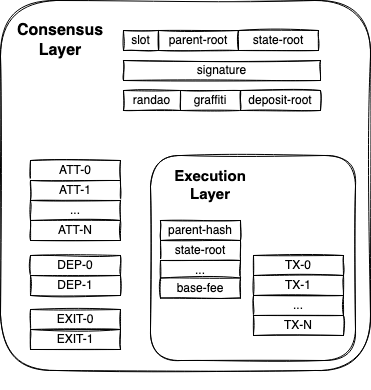
For finish customers and utility builders, these ExecutionPayloads are the place interactions with Ethereum occur. Transactions on this layer will nonetheless be processed by execution layer purchasers (Besu, Erigon, Geth, Nethermind, and so forth.). Luckily, as a result of stability of the execution layer, The Merge introduces solely minimal breaking adjustments.
Mining & Ommer Block Fields
Put up-merge, a number of fields beforehand contained in proof of labor block headers turn out to be unused as they’re irrelevant to proof of stake. With a purpose to reduce disruption to tooling and infrastructure, these fields are set to 0, or their information construction’s equal, fairly than being totally faraway from the info construction. The total adjustments to dam fields will be present in EIP-3675.
| Discipline | Fixed worth | Remark |
|---|---|---|
| ommers | [] | RLP([]) = 0xc0 |
| ommersHash | 0x1dcc4de8dec75d7aab85b567b6ccd41ad312451b948a7413f0a142fd40d49347 | = Keccak256(RLP([])) |
| issue | 0 | |
| nonce | 0x0000000000000000 |
As a result of proof of stake doesn’t naturally produce ommers (a.ok.a. uncle blocks) like proof of labor, the checklist of those in every block (ommers) will probably be empty, and the hash of this checklist (ommersHash) will turn out to be the RLP-encoded hash of an empty checklist. Equally, as a result of issue and nonce are options of proof of labor, these will probably be set to 0, whereas respecting their byte-size values.
mixHash, one other mining-related area, will not be set to 0 however will as a substitute comprise the beacon chain’s RANDAO worth. Extra on this beneath.
BLOCKHASH & DIFFICULTY opcodes adjustments
Put up-merge, the BLOCKHASH opcode will nonetheless be obtainable to be used, however given that it’ll now not be solid by the proof of labor hashing course of, the pseudorandomness offered by this opcode will probably be a lot weaker.
Relatedly, the DIFFICULTY opcode (0x44) will probably be up to date and renamed to PREVRANDAO. Put up-merge, it is going to return the output of the randomness beacon offered by the beacon chain. This opcode will thus be a stronger, albeit nonetheless biasable, supply of randomness for utility builders to make use of than BLOCKHASH.
The worth uncovered by PREVRANDAO will probably be saved within the ExecutionPayload the place mixHash, a price related to proof of labor computation, was saved. The payload’s mixHash area can even be renamed prevRandao.
Right here is an illustration of how the DIFFICULTY & PREVRANDAO opcodes work pre and post-merge:
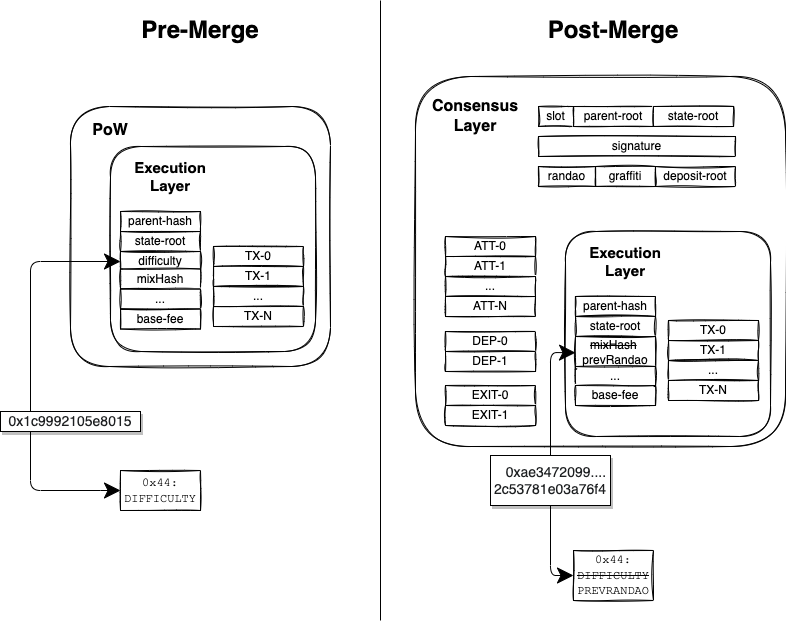
Pre-merge, we see the 0x44 opcode returns the issue area within the block header. Put up-merge, the opcode, renamed to PREVRANDAO, factors to the header area which beforehand contained mixHash and now shops the prevRandao worth from the beacon chain state.
This variation, formalized in EIP-4399, additionally gives on-chain purposes a solution to assess whether or not The Merge has occurred. From the EIP:
Moreover, adjustments proposed by this EIP enable for good contracts to find out whether or not the improve to the PoS has already occurred. This may be accomplished by analyzing the return worth of the DIFFICULTY opcode. A worth better than 2**64 signifies that the transaction is being executed within the PoS block.
Block time
The Merge will affect the typical block time on Ethereum. At present beneath proof of labor, blocks are available in on common each ~13 seconds with a good quantity of variance in precise block occasions. Underneath proof of stake, blocks are available in precisely every 12 seconds besides when a slot is missed both as a result of a validator is offline or as a result of they don’t submit a block in time. In observe, this at present occurs in <1% of slots.
This suggests a ~1 second discount of common block occasions on the community. Sensible contracts which assume a specific common block time of their calculations might want to take this into consideration.
Finalized Blocks & Protected Head
Underneath proof of labor there may be all the time the potential for reorgs. Purposes often anticipate a number of blocks to be mined on prime of a brand new head earlier than treating it as unlikely to be faraway from the canonical chain, or “confirmed”. After The Merge, we as a substitute have the ideas of finalized blocks and secure head uncovered on the execution layer. These blocks can be utilized extra reliably than the “confirmed” proof of labor blocks however require a shift in understanding to make use of accurately.
A finalized block is one which has been accepted as canonical by >2/3 of validators. To create a conflicting block, an attacker must burn not less than 1/3 of the entire staked ether. Whereas stake quantities might fluctuate, such an assault is all the time anticipated to price the attacker tens of millions of ETH.
A secure head block is one which has been justified by the Beacon Chain, that means that >2/3 of validators have attested to it. Underneath regular community circumstances, we count on it to be included within the canonical chain and ultimately finalized. For this block to not be a part of the canonical chain, a majority of validators would should be colluding to assault the community, or the community must be experiencing excessive ranges of latency in block propagation. Put up-merge, execution layer APIs (e.g. JSON RPC) will expose the secure head utilizing a secure tag.
Finalized blocks can even be uncovered through JSON RPC, through a brand new finalized flag. These can then function a stronger substitute for proof of labor confirmations. The desk beneath summarizes this:
| Block Kind | Consensus Mechanism | JSON RPC | Situations for reorg |
|---|---|---|---|
| head | Proof of Work | newest | To be anticipated, should be used with care. |
| secure head | Proof of Stake | secure | Potential, requires both giant community delay or assault on community. |
| confirmed | Proof of Work | N/A | Unlikely, requires a majority of hashrate to mine a competing chain of depth > # of confirmations. |
| finalized | Proof of Stake | finalized | Extraordinarily unlikely, requires >2/3 of validators to finalize a competing chain, requiring not less than 1/3 to be slashed. |
Word: the JSON RPC specification continues to be beneath energetic improvement. Naming adjustments ought to nonetheless be anticipated.
Subsequent Steps
We hope this publish helps utility builders put together for the much-anticipated transition to proof of stake. Within the subsequent few weeks, a long-lived testnet will probably be made obtainable for testing by the broader neighborhood. There’s additionally an upcoming Merge neighborhood name for infrastructure, tooling and utility builders to ask questions and listen to the newest technical updates about The Merge. See you there 👋🏻
Thanks to Mikhail Kalinin, Danny Ryan & Matt Garnett for reviewing drafts of this publish.

