


Particular due to Vlad Zamfir, Chris Barnett and Dominic Williams for concepts and inspiration
In a current weblog put up I outlined some partial options to scalability, all of which match into the umbrella of Ethereum 1.0 because it stands. Specialised micropayment protocols similar to channels and probabilistic cost techniques could possibly be used to make small funds, utilizing the blockchain both just for eventual settlement, or solely probabilistically. For some computation-heavy purposes, computation could be executed by one celebration by default, however in a means that may be “pulled down” to be audited by the whole chain if somebody suspects malfeasance. Nevertheless, these approaches are all essentially application-specific, and much from excellent. On this put up, I describe a extra complete strategy, which, whereas coming at the price of some “fragility” considerations, does present an answer which is way nearer to being common.
Understanding the Goal
To start with, earlier than we get into the main points, we have to get a a lot deeper understanding of what we really need. What will we imply by scalability, notably in an Ethereum context? Within the context of a Bitcoin-like forex, the reply is comparatively easy; we would like to have the ability to:
- Course of tens of hundreds of transactions per second
- Present a transaction payment of lower than $0.001
- Do all of it whereas sustaining safety towards at the least 25% assaults and with out extremely centralized full nodes
The primary objective alone is straightforward; we simply take away the block dimension restrict and let the blockchain naturally develop till it turns into that giant, and the financial system takes care of itself to drive smaller full nodes to proceed to drop out till the one three full nodes left are run by GHash.io, Coinbase and Circle. At that time, some stability will emerge between charges and dimension, as excessize dimension results in extra centralization which ends up in extra charges as a result of monopoly pricing. So as to obtain the second, we are able to merely have many altcoins. To attain all three mixed, nonetheless, we have to break via a basic barrier posed by Bitcoin and all different current cryptocurrencies, and create a system that works with out the existence of any “full nodes” that must course of each transaction.
In an Ethereum context, the definition of scalability will get slightly extra sophisticated. Ethereum is, essentially, a platform for “dapps”, and inside that mandate there are two sorts of scalability which are related:
- Enable tons and many individuals to construct dapps, and maintain the transaction charges low
- Enable every particular person dapp to be scalable in accordance with a definition just like that for Bitcoin
The primary is inherently simpler than the second. The one property that the “construct tons and many alt-Etherea” strategy doesn’t have is that every particular person alt-Ethereum has comparatively weak safety; at a dimension of 1000 alt-Etherea, each could be susceptible to a 0.1% assault from the perspective of the entire system (that 0.1% is for externally-sourced assaults; internally-sourced assaults, the equal of GHash.io and Discus Fish colluding, would take solely 0.05%). If we are able to discover a way for all alt-Etherea to share consensus energy, eg. some model of merged mining that makes every chain obtain the energy of the whole pack with out requiring the existence of miners that learn about all chains concurrently, then we might be executed.
The second is extra problematic, as a result of it results in the identical fragility property that arises from scaling Bitcoin the forex: if each node sees solely a small a part of the state, and arbitrary quantities of BTC can legitimately seem in any a part of the state originating from any a part of the state (such fungibility is a part of the definition of a forex), then one can intuitively see how forgery assaults may unfold via the blockchain undetected till it’s too late to revert every part with out substantial system-wide disruption by way of a worldwide revert.
Reinventing the Wheel
We’ll begin off by describing a comparatively easy mannequin that does present each sorts of scalability, however gives the second solely in a really weak and dear means; primarily, we’ve got simply sufficient intra-dapp scalability to make sure asset fungibility, however not way more. The mannequin works as follows:
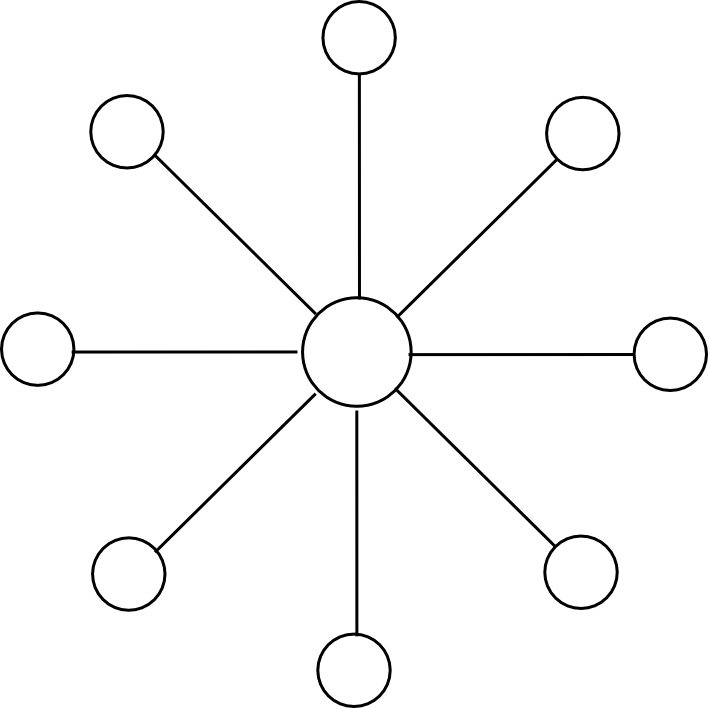
Suppose that the worldwide Ethereum state (ie. all accounts, contracts and balances) is break up up into N components (“substates”) (assume 10 <= N <= 200). Anybody can arrange an account on any substate, and one can ship a transaction to any substate by including a substate quantity flag to it, however atypical transactions can solely ship a message to an account in the identical substate because the sender. Nevertheless, to make sure safety and cross-transmissibility, we add some extra options. First, there may be additionally a particular “hub substate”, which comprises solely a listing of messages, of the shape [dest_substate, address, value, data]. Second, there may be an opcode CROSS_SEND, which takes these 4 parameters as arguments, and sends such a one-way message enroute to the vacation spot substate.
Miners mine blocks on some substate s[j], and every block on s[j] is concurrently a block within the hub chain. Every block on s[j] has as dependencies the earlier block on s[j] and the earlier block on the hub chain. For instance, with N = 2, the chain would look one thing like this:
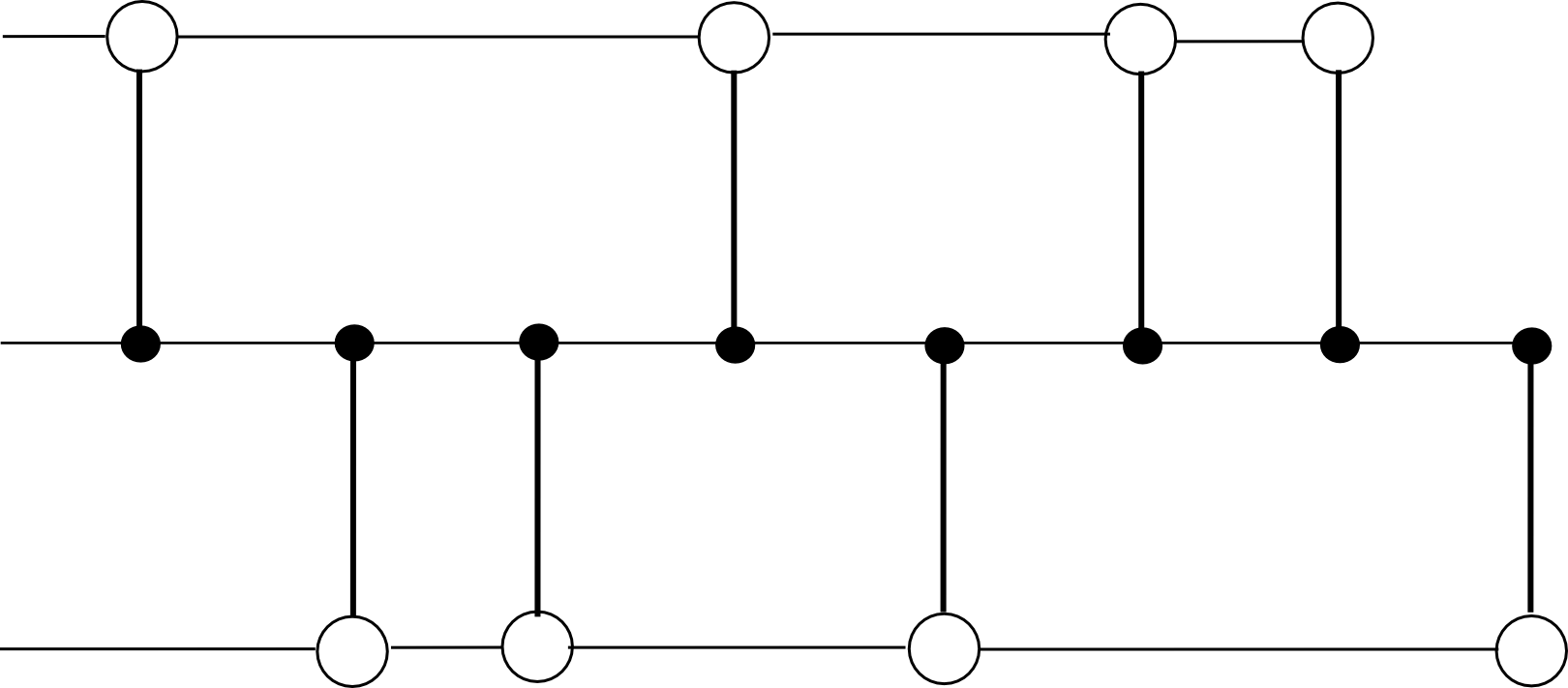
The block-level state transition perform, if mining on substate s[j], does three issues:
- Processes state transitions within s[j]
- If any of these state transitions creates a CROSS_SEND, provides that message to the hub chain
- If any messages are on the hub chain with dest_substate = j, removes the messages from the hub chain, sends the messages to their vacation spot addresses on s[j], and processes all ensuing state transitions
From a scalability perspective, this offers us a considerable enchancment. All miners solely want to concentrate on two out of the whole N + 1 substates: their very own substate, and the hub substate. Dapps which are small and self-contained will exist on one substate, and dapps that wish to exist throughout a number of substates might want to ship messages via the hub. For instance a cross-substate forex dapp would keep a contract on all substates, and every contract would have an API that enables a consumer to destroy forex items inside of 1 substate in change for the contract sending a message that might result in the consumer being credited the identical quantity on one other substate.
Messages going via the hub do must be seen by each node, so these will likely be costly; nonetheless, within the case of ether or sub-currencies we solely want the switch mechanism for use sometimes for settlement, doing off-chain inter-substate change for many transfers.
Assaults, Challenges and Responses
Now, allow us to take this easy scheme and analyze its safety properties (for illustrative functions, we’ll use N = 100). To start with, the scheme is safe towards double-spend assaults as much as 50% of the whole hashpower; the reason being that each sub-chain is basically merge-mined with each different sub-chain, with every block reinforcing the safety of all sub-chains concurrently.
Nevertheless, there are extra harmful courses of assaults as nicely. Suppose {that a} hostile attacker with 4% hashpower jumps onto one of many substates, thereby now comprising 80% of the mining energy on it. Now, that attacker mines blocks which are invalid – for instance, the attacker features a state transition that creates messages sending 1000000 ETH to each different substate out of nowhere. Different miners on the identical substate will acknowledge the hostile miner’s blocks as invalid, however that is irrelevant; they’re solely a really small a part of the whole community, and solely 20% of that substate. The miners on different substates do not know that the attacker’s blocks are invalid, as a result of they don’t have any data of the state of the “captured substate”, so at first look it appears as if they could blindly settle for them.
Thankfully, right here the answer right here is extra complicated, however nonetheless nicely inside the attain of what we at the moment know works: as quickly as one of many few reputable miners on the captured substate processes the invalid block, they may see that it is invalid, and subsequently that it is invalid in some explicit place. From there, they may have the ability to create a light-client Merkle tree proof exhibiting that that exact a part of the state transition was invalid. To elucidate how this works in some element, a lightweight consumer proof consists of three issues:
- The intermediate state root that the state transition began from
- The intermediate state root that the state transition ended at
- The subset of Patricia tree nodes which are accessed or modified within the technique of executing the state transition
The primary two “intermediate state roots” are the roots of the Ethereum Patricia state tree earlier than and after executing the transaction; the Ethereum protocol requires each of those to be in each block. The Patricia state tree nodes offered are wanted so as to the verifier to comply with alongside the computation themselves, and see that the identical result’s arrived on the finish. For instance, if a transaction finally ends up modifying the state of three accounts, the set of tree nodes that can must be offered may look one thing like this:
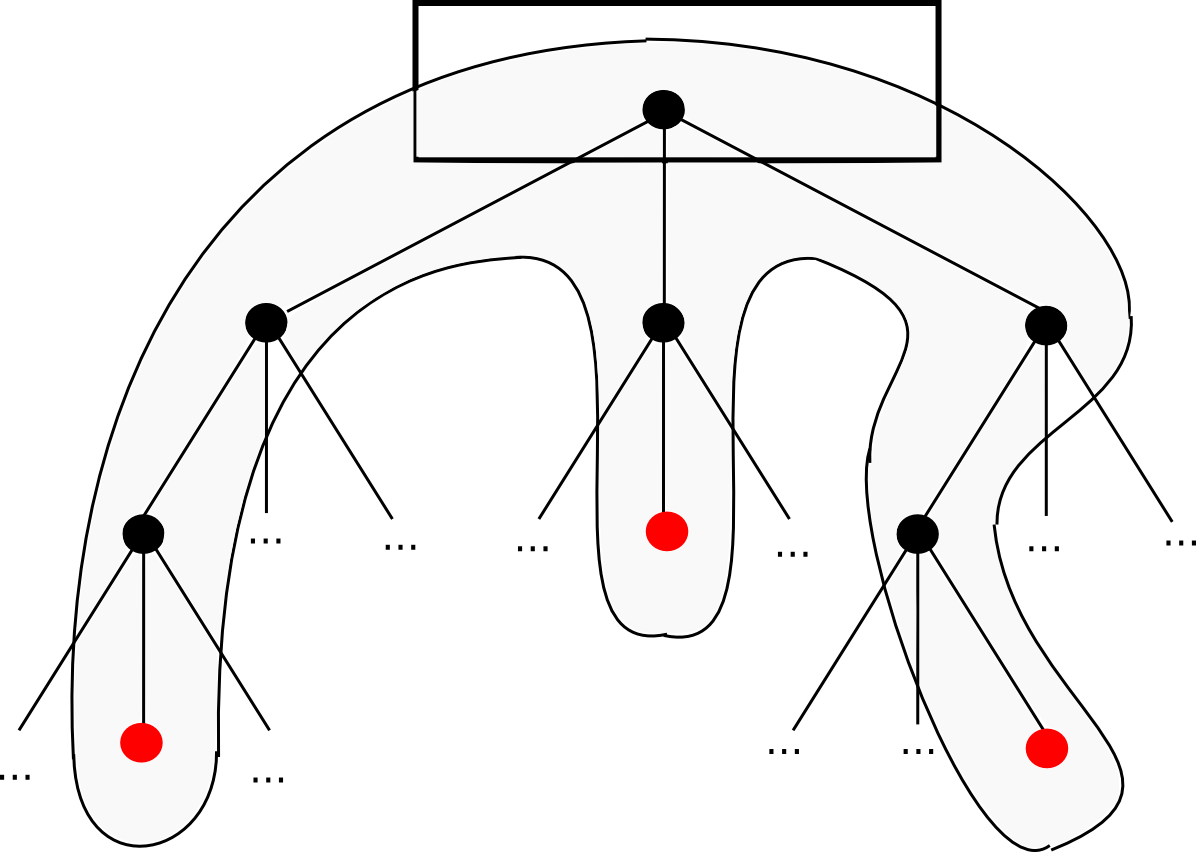
Technically, the proof ought to embody the set of Patricia tree nodes which are wanted to entry the intermediate state roots and the transaction as nicely, however that is a comparatively minor element. Altogether, one can consider the proof as consisting of the minimal quantity of data from the blockchain wanted to course of that exact transaction, plus some further nodes to show that these bits of the blockchain are literally within the present state. As soon as the whistleblower creates this proof, they may then be broadcasted to the community, and all different miners will see the proof and discard the faulty block.
The toughest class of assault of all, nonetheless, is what is named a “information unavailability assault”. Right here, think about that the miner sends out solely the block header to the community, in addition to the listing of messages so as to add to the hub, however doesn’t present any of the transactions, intermediate state roots or anything. Now, we’ve got an issue. Theoretically, it’s solely doable that the block is totally reputable; the block might have been correctly constructed by gathering some transactions from a number of millionaires who occurred to be actually beneficiant. In actuality, in fact, this isn’t the case, and the block is a fraud, however the truth that the information is just not accessible in any respect makes it not possible to assemble an affirmative proof of the fraud. The 20% trustworthy miners on the captured substate might yell and squeal, however they don’t have any proof in any respect, and any protocol that did heed their phrases would essentially fall to a 0.2% denial-of-service assault the place the miner captures 20% of a substate and pretends that the opposite 80% of miners on that substate are conspiring towards him.
To unravel this downside, we’d like one thing referred to as a challenge-response protocol. Basically, the mechanism works as follows:
- Trustworthy miners on the captured substate see the header-only block.
- An trustworthy miner sends out a “problem” within the type of an index (ie. a quantity).
- If the producer of the block can submit a “response” to the problem, consisting of a light-client proof that the transaction execution on the given index was executed legitimately (or a proof that the given index is larger than the variety of transactions within the block), then the problem is deemed answered.
- If a problem goes unanswered for a number of seconds, miners on different substates think about the block suspicious and refuse to mine on it (the game-theoretic justification for why is identical as at all times: as a result of they believe that others will use the identical technique, and there’s no level mining on a substate that can quickly be orphaned)
Observe that the mechanism requires a number of added complexities on order to work. If a block is printed alongside all of its transactions aside from a number of, then the challenge-response protocol might shortly undergo all of them and discard the block. Nevertheless, if a block was printed really headers-only, then if the block contained lots of of transactions, lots of of challenges could be required. One heuristic strategy to fixing the issue is that miners receiving a block ought to privately decide some random nonces, ship out a number of challenges for these nonces to some identified miners on the possibly captured substate, and if responses to all challenges don’t come again instantly deal with the block as suspect. Observe that the miner does NOT broadcast the problem publicly – that might give a possibility for an attacker to shortly fill within the lacking information.
The second downside is that the protocol is susceptible to a denial-of-service assault consisting of attackers publishing very very many challenges to reputable blocks. To unravel this, making a problem ought to have some price – nonetheless, if this price is just too excessive then the act of creating a problem would require a really excessive “altruism delta”, maybe so excessive that an assault will finally come and nobody will problem it. Though some could also be inclined to unravel this with a market-based strategy that locations accountability for making the problem on no matter events find yourself robbed by the invalid state transition, it’s price noting that it is doable to give you a state transition that generates new funds out of nowhere, stealing from everybody very barely by way of inflation, and in addition compensates rich coin holders, making a theft the place there isn’t a concentrated incentive to problem it.
For a forex, one “straightforward answer” is capping the worth of a transaction, making the whole downside have solely very restricted consequence. For a Turing-complete protocol the answer is extra complicated; one of the best approaches probably contain each making challenges costly and including a mining reward to them. There will likely be a specialised group of “problem miners”, and the speculation is that they are going to be detached as to which challenges to make, so even the tiniest altruism delta, enforced by software program defaults, will drive them to make right challenges. One might even attempt to measure how lengthy challenges take to get responded, and extra extremely reward those that take longer.
The Twelve-Dimensional Hypercube
Observe: that is NOT the identical because the erasure-coding Borg dice. For more information on that, see right here: https://weblog.ethereum.org/2014/08/16/secret-sharing-erasure-coding-guide-aspiring-dropbox-decentralizer/
We are able to see two flaws within the above scheme. First, the justification that the challenge-response protocol will work is reasonably iffy at greatest, and has poor degenerate-case habits: a substate takeover assault mixed with a denial of service assault stopping challenges might doubtlessly drive an invalid block into a sequence, requiring an eventual day-long revert of the whole chain when (if?) the smoke clears. There may be additionally a fragility part right here: an invalid block in any substate will invalidate all subsequent blocks in all substates. Second, cross-substate messages should nonetheless be seen by all nodes. We begin off by fixing the second downside, then proceed to indicate a doable protection to make the primary downside barely much less unhealthy, after which lastly get round to fixing it fully, and on the identical time eliminating proof of labor.
The second flaw, the expensiveness of cross-substate messages, we resolve by changing the blockchain mannequin from this:
To this:
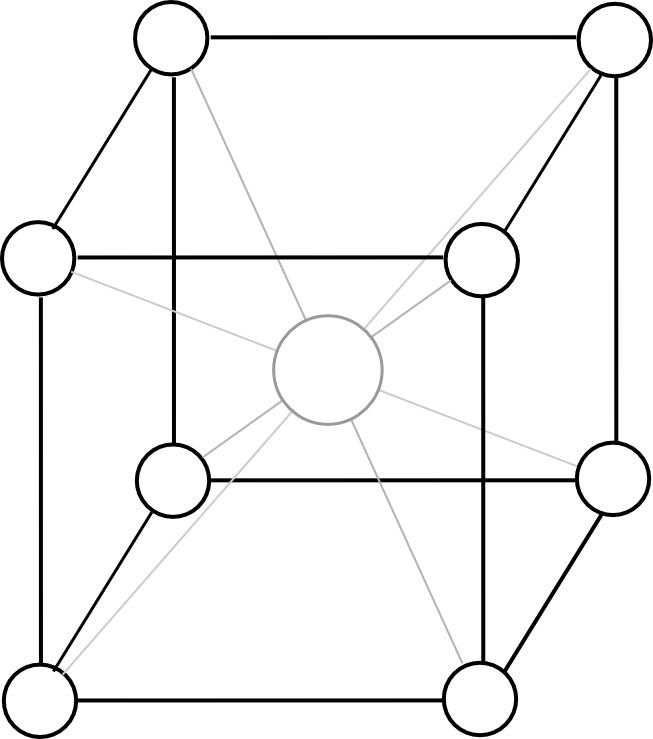
Besides the dice ought to have twelve dimensions as a substitute of three. Now, the protocol appears to be like as follows:
- There exist 2N substates, every of which is recognized by a binary string of size N (eg. 0010111111101). We outline the Hamming distance H(S1, S2) because the variety of digits which are completely different between the IDs of substates S1 and S2 (eg. HD(00110, 00111) = 1, HD(00110, 10010) = 2, and so forth).
- The state of every substate shops the atypical state tree as earlier than, but additionally an outbox.
- There exists an opcode, CROSS_SEND, which takes 4 arguments [dest_substate, to_address, value, data], and registers a message with these arguments within the outbox of S_from the place S_from is the substate from which the opcode was referred to as
- All miners should “mine an edge”; that’s, legitimate blocks are blocks which modify two adjoining substates S_a and S_b, and may embody transactions for both substate. The block-level state transition perform is as follows:
- Course of all transactions so as, making use of the state transitions to S_a or S_b as wanted.
- Course of all messages within the outboxes of S_a and S_b so as. If the message is within the outbox of S_a and has ultimate vacation spot S_b, course of the state transitions, and likewise for messages from S_b to S_a. In any other case, if a message is in S_a and HD(S_b, msg.dest) < HD(S_a, msg.dest), transfer the message from the outbox of S_a to the outbox of S_b, and likewise vice versa.
- There exists a header chain maintaining observe of all headers, permitting all of those blocks to be merge-mined, and maintaining one centralized location the place the roots of every state are saved.
Basically, as a substitute of travelling via the hub, messages make their means across the substates alongside edges, and the always decreasing Hamming distance ensures that every message at all times finally will get to its vacation spot.
The important thing design resolution right here is the association of all substates right into a hypercube. Why was the dice chosen? One of the best ways to consider the dice is as a compromise between two excessive choices: on the one hand the circle, and then again the simplex (principally, 2N-dimensional model of a tetrahedron). In a circle, a message would wish to journey on common 1 / 4 of the way in which throughout the circle earlier than it will get to its vacation spot, which means that we make no effectivity positive aspects over the plain outdated hub-and-spoke mannequin.
In a simplex, each pair of substates has an edge, so a cross-substate message would get throughout as quickly as a block between these two substates is produced. Nevertheless, with miners selecting random edges it could take a very long time for a block on the suitable edge to look, and extra importantly customers watching a specific substate would must be at the least gentle purchasers on each different substate so as to validate blocks which are related to them. The hypercube is an ideal stability – every substate has a logarithmically rising variety of neighbors, the size of the longest path grows logarithmically, and block time of any explicit edge grows logarithmically.
Observe that this algorithm has primarily the identical flaws because the hub-and-spoke strategy – particularly, that it has unhealthy degenerate-case habits and the economics of challenge-response protocols are very unclear. So as to add stability, one strategy is to change the header chain considerably.
Proper now, the header chain could be very strict in its validity necessities – if any block anyplace down the header chain seems to be invalid, all blocks in all substates on prime of which are invalid and should be redone. To mitigate this, we are able to require the header chain to easily maintain observe of headers, so it may possibly include each invalid headers and even a number of forks of the identical substate chain. So as to add a merge-mining protocol, we implement exponential subjective scoring however utilizing the header chain as an absolute widespread timekeeper. We use a low base (eg. 0.75 as a substitute of 0.99) and have a most penalty issue of 1 / 2N to take away the profit from forking the header chain; for these not nicely versed within the mechanics of ESS, this principally means “permit the header chain to include all headers, however use the ordering of the header chain to penalize blocks that come later with out making this penalty too strict”. Then, we add a delay on cross-substate messages, so a message in an outbox solely turns into “eligible” if the originating block is at the least a number of dozen blocks deep.
Proof of Stake
Now, allow us to work on porting the protocol to nearly-pure proof of stake. We’ll ignore nothing-at-stake points for now; Slasher-like protocols plus exponential subjective scoring can resolve these considerations, and we are going to talk about including them in later. Initially, our goal is to indicate learn how to make the hypercube work with out mining, and on the identical time partially resolve the fragility downside. We’ll begin off with a proof of exercise implementation for multichain. The protocol works as follows:
- There exist 2N substates indentified by binary string, as earlier than, in addition to a header chain (which additionally retains observe of the most recent state root of every substate).
- Anybody can mine an edge, as earlier than, however with a decrease issue. Nevertheless, when a block is mined, it should be printed alongside the entire set of Merkle tree proofs so {that a} node with no prior info can absolutely validate all state transitions within the block.
- There exists a bonding protocol the place an handle can specify itself as a possible signer by submitting a bond of dimension B (richer addresses might want to create a number of sub-accounts). Potential signers are saved in a specialised contract C[s] on every substate s.
- Based mostly on the block hash, a random 200 substates s[i] are chosen, and a search index 0 <= ind[i] < 2^160 is chosen for every substate. Outline signer[i] because the proprietor of the primary handle in C[s[i]] after index ind[i]. For the block to be legitimate, it should be signed by at the least 133 of the set signer[0] … signer[199].
To truly examine the validity of a block, the consensus group members would do two issues. First, they’d examine that the preliminary state roots offered within the block match the corresponding state roots within the header chain. Second, they’d course of the transactions, and be sure that the ultimate state roots match the ultimate state roots offered within the header chain and that every one trie nodes wanted to calculate the replace can be found someplace within the community. If each checks cross, they signal the block, and if the block is signed by sufficiently many consensus group members it will get added to the header chain, and the state roots for the 2 affected blocks within the header chain are up to date.
And that is all there may be to it. The important thing property right here is that each block has a randomly chosen consensus group, and that group is chosen from the worldwide state of all account holders. Therefore, until an attacker has at the least 33% of the stake in the whole system, it is going to be nearly not possible (particularly, 2-70 chance, which with 230 proof of labor falls nicely into the realm of cryptographic impossiblity) for the attacker to get a block signed. And with out 33% of the stake, an attacker will be unable to stop reputable miners from creating blocks and getting them signed.
This strategy has the profit that it has good degenerate-case habits; if a denial-of-service assault occurs, then chances are high that just about no blocks will likely be produced, or at the least blocks will likely be produced very slowly, however no injury will likely be executed.
Now, the problem is, how will we additional cut back proof of labor dependence, and add in blockmaker and Slasher-based protocols? A easy strategy is to have a separate blockmaker protocol for each edge, simply as within the single-chain strategy. To incentivize blockmakers to behave actually and never double-sign, Slasher may also be used right here: if a signer indicators a block that finally ends up not being in the principle chain, they get punished. Schelling level results be certain that everybody has the motivation to comply with the protocol, as they guess that everybody else will (with the extra minor pseudo-incentive of software program defaults to make the equilibrium stronger).
A full EVM
These protocols permit us to ship one-way messages from one substate to a different. Nevertheless, a technique messages are restricted in performance (or reasonably, they’ve as a lot performance as we would like them to have as a result of every part is Turing-complete, however they aren’t at all times the nicest to work with). What if we are able to make the hypercube simulate a full cross-substate EVM, so you possibly can even name features which are on different substates?
Because it seems, you possibly can. The secret is so as to add to messages an information construction referred to as a continuation. For instance, suppose that we’re in the midst of a computation the place a contract calls a contract which creates a contract, and we’re at the moment executing the code that’s creating the interior contract. Thus, the place we’re within the computation appears to be like one thing like this:
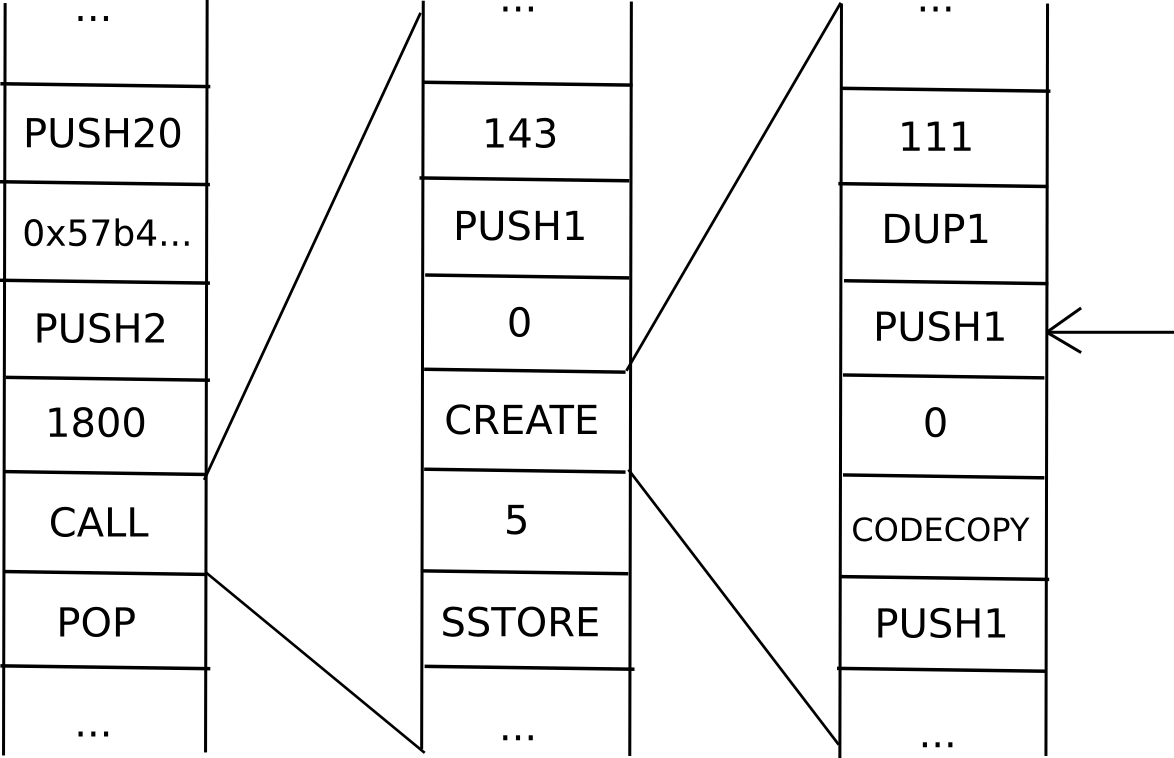
Now, what’s the present “state” of this computation? That’s, what’s the set of all the information that we’d like to have the ability to pause the computation, after which utilizing the information resume it in a while? In a single occasion of the EVM, that is simply this system counter (ie. the place we’re within the code), the reminiscence and the stack. In a state of affairs with contracts calling one another, we’d like that information for the whole “computational tree”, together with the place we’re within the present scope, the dad or mum scope, the dad or mum of that, and so forth again to the unique transaction:
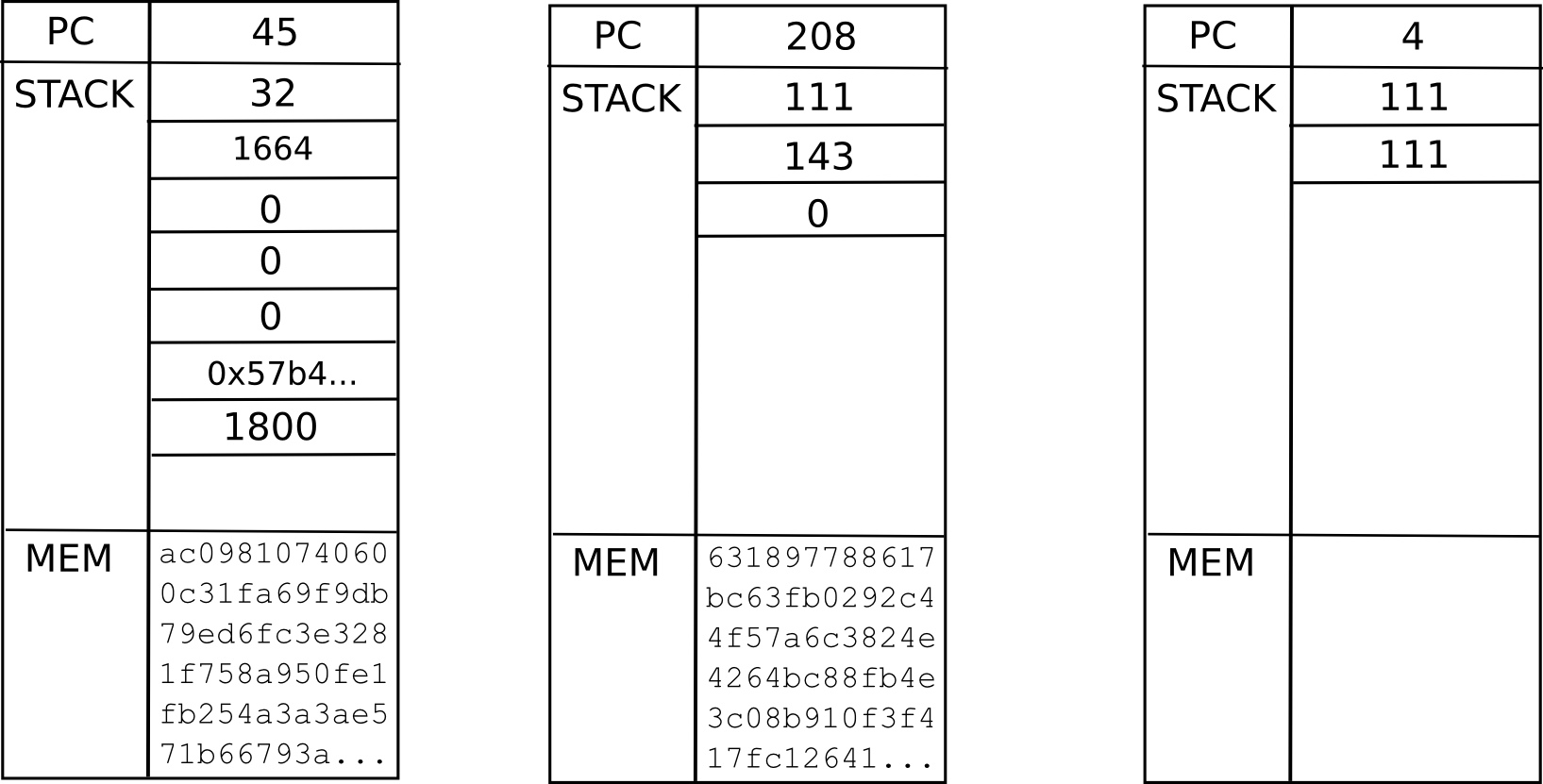
That is referred to as a “continuation”. To renew an execution from this continuation, we merely resume every computation and run it to completion in reverse order (ie. end the innermost first, then put its output into the suitable house in its dad or mum, then end the dad or mum, and so forth). Now, to make a completely scalable EVM, we merely substitute the idea of a one-way message with a continuation, and there we go.
After all, the query is, will we even wish to go this far? To start with, going between substates, such a digital machine could be extremely inefficient; if a transaction execution must entry a complete of ten contracts, and every contract is in some random substate, then the method of operating via that whole execution will take a median of six blocks per transmission, instances two transmissions per sub-call, instances ten sub-calls – a complete of 120 blocks. Moreover, we lose synchronicity; if A calls B as soon as after which once more, however between the 2 calls C calls B, then C could have discovered B in {a partially} processed state, doubtlessly opening up safety holes. Lastly, it is troublesome to mix this mechanism with the idea of reverting transaction execution if transactions run out of fuel. Thus, it might be simpler to not trouble with continuations, and reasonably decide for easy one-way messages; as a result of the language is Turing-complete continuations can at all times be constructed on prime.
On account of the inefficiency and instability of cross-chain messages irrespective of how they’re executed, most dapps will wish to dwell solely within a single sub-state, and dapps or contracts that continuously speak to one another will wish to dwell in the identical sub-state as nicely. To forestall completely everybody from residing on the identical sub-state, we are able to have the fuel limits for every substate “spill over” into one another and attempt to stay comparable throughout substates; then, market forces will naturally be certain that common substates turn into costlier, encouraging marginally detached customers and dapps to populate contemporary new lands.
Not So Quick
So, what issues stay? First, there may be the information availability downside: what occurs when the entire full nodes on a given sub-state disappear? If such a state of affairs occurs, the sub-state information disappears ceaselessly, and the blockchain will primarily must be forked from the final block the place the entire sub-state information really is thought. This may result in double-spends, some damaged dapps from duplicate messages, and so forth. Therefore, we have to primarily make sure that such a factor won’t ever occur. It is a 1-of-N belief mannequin; so long as one trustworthy node shops the information we’re high quality. Single-chain architectures even have this belief mannequin, however the concern will increase when the variety of nodes anticipated to retailer every bit of knowledge decreases – because it does right here by an element of 2048. The priority is mitigated by the existence of altruistic nodes together with blockchain explorers, however even that can turn into a difficulty if the community scales up a lot that no single information heart will have the ability to retailer the whole state.
Second, there’s a fragility downside: if any block anyplace within the system is mis-processed, then that would result in ripple results all through the whole system. A cross-substate message may not be despatched, or is likely to be re-sent; cash is likely to be double-spent, and so forth. After all, as soon as an issue is detected it could inevitably be detected, and it could possibly be solved by reverting the entire chain from that time, however it’s solely unclear how typically such conditions will come up. One fragility answer is to have a separate model of ether in every substate, permitting ethers in numerous substates to drift towards one another, after which add message redundancy options to high-level languages, accepting that messages are going to be probabilistic; this may permit the variety of nodes verifying every header to shrink to one thing like 20, permitting much more scalability, although a lot of that might be absorbed by an elevated variety of cross-substate messages doing error-correction.
A 3rd situation is that the scalability is proscribed; each transaction must be in a substate, and each substate must be in a header that each node retains observe of, so if the utmost processing energy of a node is N transactions, then the community can course of as much as N2 transactions. An strategy so as to add additional scalability is to make the hypercube construction hierarchical in some trend – think about the block headers within the header chain as being transactions, and picture the header chain itself being upgraded from a single-chain mannequin to the very same hypercube mannequin as described right here – that might give N3 scalability, and making use of it recursively would give one thing very very similar to tree chains, with exponential scalability – at the price of elevated complexity, and making transactions that go all the way in which throughout the state house way more inefficient.
Lastly, fixing the variety of substates at 4096 is suboptimal; ideally, the quantity would develop over time because the state grew. One possibility is to maintain observe of the variety of transactions per substate, and as soon as the variety of transactions per substate exceeds the variety of substates we are able to merely add a dimension to the dice (ie. double the variety of substates). Extra superior approaches contain utilizing minimal lower algorithms such because the comparatively easy Karger’s algorithm to attempt to break up every substate in half when a dimension is added. Nevertheless, such approaches are problematic, each as a result of they’re complicated and since they contain unexpectedly massively rising the fee and latency of dapps that find yourself by chance getting lower throughout the center.
Various Approaches
After all, hypercubing the blockchain is just not the one strategy to creating the blockchain scale. One very promising various is to have an ecosystem of a number of blockchains, some application-specific and a few Ethereum-like generalized scripting environments, and have them “speak to” one another in some trend – in observe, this typically means having all (or at the least some) of the blockchains keep “gentle purchasers” of one another within their very own states. The problem there is determining learn how to have all of those chains share consensus, notably in a proof-of-stake context. Ideally, the entire chains concerned in such a system would reinforce one another, however how would one do this when one cannot decide how beneficial every coin is? If an attacker has 5% of all A-coins, 3% of all B-coins and 80% of all C-coins, how does A-coin know whether or not it is B-coin or C-coin that ought to have the better weight?
One strategy is to make use of what is basically Ripple consensus between chains – have every chain resolve, both initially on launch or over time by way of stakeholder consensus, how a lot it values the consensus enter of one another chain, after which permit transitivity results to make sure that every chain protects each different chain over time. Such a system works very nicely, because it’s open to innovation – anybody can create new chains at any level with arbitrarily guidelines, and all of the chains can nonetheless match collectively to strengthen one another; fairly probably, sooner or later we might even see such an inter-chain mechanism current between most chains, and a few giant chains, maybe together with older ones like Bitcoin and architectures like a hypercube-based Ethereum 2.0, resting on their very own merely for historic causes. The thought right here is for a really decentralized design: everybody reinforces one another, reasonably than merely hugging the strongest chain and hoping that that doesn’t fall prey to a black swan assault.

